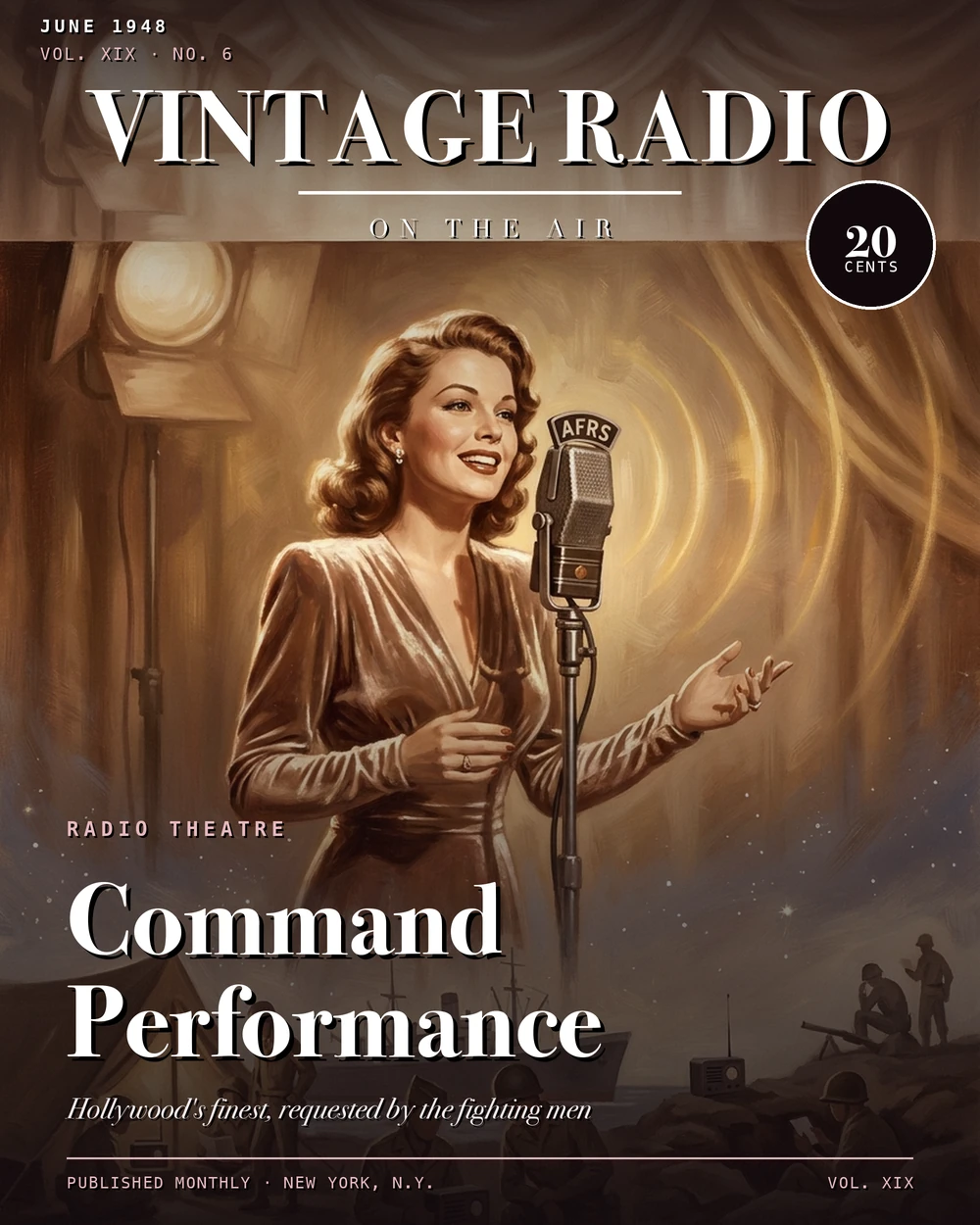
Command Performance
The Idea That Nobody Got Paid For
Command Performance started from a simple premise that turned out to be almost impossible to pull off in peacetime terms: let the troops choose their own entertainment. In 1942, the War Department asked Louis G. Cowan of its Radio Division to come up with a format for entertaining servicemen overseas. Cowan's answer was to flip the usual broadcast relationship entirely. As Edward M. Kirby and Jack W. Harris put it in Star-Spangled Radio, the GI "who was trained to obey commands could now command anything he wanted from the radio world." The soldiers were in charge. The stars would deliver.
What made this workable — and what made it remarkable — was that nobody took a dime. The production staff donated their time. Every performer appeared for free. Both CBS and NBC gave free use of their network studios. It was estimated that producing the show commercially would have cost $75,000 a week, which in 1942 was a staggering figure; a Tune In magazine piece in 1943 put the talent cost alone at around $50,000 a week if anyone had actually been billing for it. Instead, the War Department asked, and Hollywood said yes. Bob Burns, one of the show's regular performers, summed it up: the show was "so important and expensive that only Uncle Sam is big enough to sponsor it."
The first broadcast went out on March 1, 1942, hosted by Eddie Cantor and featuring a recording of the Joe Louis–Buddy Baer title fight. It reached roughly eleven stations in Australia, Iceland, Ireland, and the Philippines, where it was credited with lifting the spirits of American and Filipino troops during the Battle of Bataan. The show was initially produced under the Office of War Information; its early success helped pave the way for the creation of the Armed Forces Radio Service in May 1942, and from 1943 onward Command Performance ran under AFRS. By the end of the war, AFRS had some 300 stations around the globe and was shipping around 21,000 transcriptions a week to troops in Europe, Asia, and the South Pacific. Across its run through December 20, 1949, Command Performance produced more than 400 broadcasts — ranging from standard half-hours to two-hour specials.
What the Troops Asked For
The early shows were assembled from verbal requests, but mail poured in quickly and the volume of it told its own story about what soldiers actually wanted. Some requests were exactly what you'd expect: favorite stars, favorite songs. Others were stranger and more personal. One soldier asked only to hear actress Carole Landis sigh — a request Bob Hope obliged on an October 1943 broadcast. Another wanted Charles Laughton to instruct Donald Duck in the finer points of elocution. Engineers were dispatched to record birds chirping in one soldier's Indiana hometown, and to capture the sound of a nickel slot machine paying off a jackpot. Lana Turner fried a steak on stage on one filmed 1943 broadcast, the beef presented under armed guard to underscore that wartime rationing made it precious. Audio engineers traveled to fulfill other requests too: Ann Miller tap dancing in military boots, the foghorns on San Francisco Bay, Errol Flynn taking a shower, Bing Crosby mixing a bourbon and soda for Bob Hope.
That willingness to take any request seriously — absurd, sentimental, or grandiose — gave Command Performance a texture that set it apart from standard broadcast variety. The programming wasn't shaped by a sponsor's demographic targets or a network's schedule pressures. It was shaped by what homesick men actually wanted to hear, which turned out to be a much more interesting thing. Variety noted that the language on the show was "sometimes just a little more robust than is passed by standard broadcasting stations," and cited Jack Benny encouraging the troops to "give 'em hell." The major unions and show-business guilds relaxed their rules to make the program possible, with the caveat that broadcasts be heard only by military personnel.
The Talent on a Single Broadcast
The roster of performers who appeared on Command Performance reads less like a cast list and more like a census of mid-century American entertainment. On a given broadcast, a listener might hear Bing Crosby, Bob Hope, the Andrews Sisters, Red Skelton, Edgar Bergen, Ethel Waters, Spike Jones, Dinah Shore, Kay Kyser, and Charles Laughton. The comedy acts Lum and Abner and Fibber McGee and Molly shared broadcasts with Vincent Price, Bob Burns, Judy Garland, Frank Sinatra, Jimmy Durante, and George Burns and Gracie Allen. Time magazine called it "the best wartime program in America," noting an average of six or seven marquee-name guest stars per episode.
After the first year, the show moved from New York to California to make it easier to pull in Hollywood screen stars, and Ken Carpenter took over as primary announcer from Paul Douglas. Vick Knight resigned a $1,000-a-week job producing Fred Allen's New York-based comedy show to relocate west and work for free. Norman Panama and Melvin Frank — partners since the University of Chicago, where they'd written gags for Milton Berle — handled writing duties; they'd go on to write Road to Utopia, White Christmas, and The Court Jester. Glenn Wheaton, the "dollar a year" man who had first proposed the program back on December 8, 1941, directed. Major Meredith Willson, Juilliard-trained flutist and AFRS Musical Director, conducted the orchestra — fifteen years before he wrote The Music Man. Most episodes were produced before a live audience at the Vine Street Playhouse in Hollywood and recorded by electrical transcription.
Christmas, Dick Tracy, and the Specials That Stood Out
Certain broadcasts became events within the run. The Christmas Eve broadcast in 1942 was the first heard domestically — a one-hour recording hosted by Bob Hope, carried by all four networks and many independent stations at 11 p.m. Eastern. The lineup included Bing Crosby, Jack Benny, Edgar Bergen and Charlie McCarthy, Fred Allen, Red Skelton, Dinah Shore, Charles Laughton, the Andrews Sisters, Spike Jones' City Slickers, and Ethel Waters. Elmer Davis, chief of the Office of War Information, provided a foreword explaining that the broadcast was meant to forge a link between servicemen abroad and the folks on the Home Front. The Christmas shows developed their own traditions, including a six-girl harmony closing number; in the first year those singers were Judy Garland, Dinah Shore, Ginny Simms, Frances Langford, Connie Boswell, and Shirley Ross.
The single most elaborate production the show attempted came on February 5, 1945: an hour-long comedic play called Dick Tracy in B-Flat; or, For Goodness Sake, Isn't He Ever Going to Marry Tess Trueheart? — a spoof of what was then America's most popular comic strip. The cast simply doesn't exist in any other context: Bing Crosby as Dick Tracy, Bob Hope as Flat Top, Frank Sinatra as Shaky, Judy Garland as Snowflake, Dinah Shore as Tess Trueheart, Jimmy Durante as the Mole, Jerry Colonna as the Chief of Police, Frank Morgan as Vitamin Flintheart, Cass Daley as Gravel Gertie, and Harry Von Zell as Old Judge Hooper. The Andrews Sisters played the Summer Sisters. Meredith Willson conducted; the Joe Lilley Chorus backed the cast. The show managed something cartoonist Chester Gould had never done — marry Tracy to Tess — opening with a wedding scene and song ("Oh Happy, Happy, Happy Wedding Day") that faded into the squeal of tires, a machine-gun burst, and three pistol shots. Subsequent wedding scenes were interrupted by a bank robbery, a kidnapping, and a hold-up. Gould himself heard a preview at WGN's studios in May 1945; Chicago columnist Irv Kupcinet reported that "the person who chuckled heartiest was Chester Gould."
There was also an all-jive broadcast built around the orchestras of Tommy Dorsey, Lionel Hampton, Count Basie, and Spike Jones, and a "fiddle fight" between Jascha Heifetz and Jack Benny that probably landed differently depending on how seriously you took Jack Benny's violin playing. The VJ Day broadcast of August 14, 1945 was a pre-prepared 100-minute special that aired the day Japan surrendered, with Bing Crosby, Lucille Ball, Bette Davis, Marlene Dietrich, Jimmy Durante, Rita Hayworth, Danny Kaye, Orson Welles, Edward G. Robinson, and Ginger Rogers among the names on the bill. Bob Hope's July 7, 1942 broadcast, his debut as host and the show's twenty-first episode, was added to the Library of Congress National Recording Registry in 2005.
After the War, and the Spinoff That Didn't Catch
Command Performance kept going after the fighting stopped. American servicemen were stationed around the world well into the late 1940s, and the show continued transmitting specials to them through its final broadcast — the 415th in the series — in December 1949. By that year, the weekly listening audience was estimated at 95.5 million soldiers and civilians. The program was one of nine AFRS shows ended as a result of a budget cut by the Secretary of Defense.
A spinoff called Request Performance launched on CBS on October 7, 1945, running on Sundays at nine for thirty minutes, sponsored by Campbell Soups. The premise was essentially the same — requests, big talent, variety format — but something didn't transfer. Domestically produced and commercially sponsored, it lacked the urgency and punch that had made the original feel different from any other show on the air. Request Performance lasted one season, closing on April 21, 1946.
Part of what the spinoff couldn't replicate was the condition that created the original. Command Performance worked the way it did because the people making it had chosen to give something away, and because the people it was made for were far from home and asking for things that mattered to them personally. A Campbell Soups budget and a Sunday prime-time slot couldn't substitute for that. The original show, by contrast, hardly anyone at home ever heard — it went out by shortwave to the front, not over the domestic networks. What most Americans knew of it came secondhand, through the occasional special like the 1942 Christmas broadcast, or through Time's endorsement, or just through reputation. The soldiers heard it. That was the point.